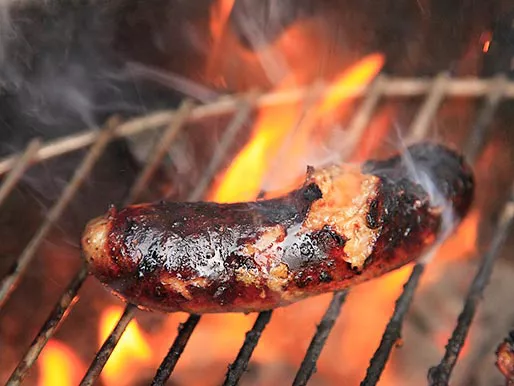
Haven’t you ever wished that your juicy pork chops were perfectly seasoned all the way to the center? Or that your pork tenderloin were just a bit juicier and fattier? Or maybe that your flavorful, smoky ribs had a decisive snap when you bit in? Sausages are like the Voltron of the grilled-pork world, combining the best characteristics of all the other popular cuts of pork into one perfectly juicy, always-tender, well-seasoned-through-and-through, universe-saving package.*
On top of all that, sausages are inexpensive (they’re made with cheap cuts, like shoulder and trimmings); are available in convenient serving-sized packages; and, even at the crummiest of supermarkets, come in at least a half dozen flavors. They really are one of the ideal foods for the backyard grill.
Ideal, that is, provided you do two simple things: start with great sausages, and don’t mess ’em up. That’s easier said than done.
With 18 pounds of sausages in hand and a few bags of coal, I fired up the grill last weekend for a marathon of prodding, poking, flipping, burning, slow-cooking, steaming, smoking, and otherwise manhandling the tube steak until I arrived at what I believe is the best method to take them from raw to cooked on the grill. Here’s what went down.
Sausage Fails
Before we get to the right way to cook sausage, let’s talk about some of the wrong ways:
The Chest-Burster
A burnt and busted-open casing, sooty flavor, juices lost to the grill gods.
What happened: This is what happens when you throw a sausage over the highest possible heat. Just like other meats, sausages contract as they cook, and in proportion to how high a temperature they’re cooked to. Cook a sausage over high heat, and the casing and outer layers will quickly get very hot, causing them to contract a great deal. Meanwhile, the raw sausage meat in the center won’t have contracted at all.
What happens next is sort of like what happens to the Incredible Hulk, but instead of the Hulk growing faster than his clothes, imagine his clothes shrinking in proportion to his body.
The casing and outer layers crack and burst open. Liquefied fat and expelled meat juices from the center pour out onto your fire, causing it to flare up and leaving a sooty deposit all over your sausage. The result is an acrid-tasting sausage, with a dry, juiceless center.
An inedible, raw center and a burnt, cracked exterior. Simultaneously overcooked and undercooked. No good.
What happened: Another product of high-heat cooking. This time, you wise up and add the sausages to a moderately hot grill. No good: You still end up with a sausage that cooks too fast, so the exterior is overcooked before the center has a chance to come up to temperature.
The Unloved Grandmother
Okay, so this time, you take it to the opposite extreme, cooking the sausage the entire way through on the cooler side of the grill. You get a tiny bit of browning, no bursting at all, and when you pull it off the heat, it looks plump and juicy as can be. But within moments, it deflates like a sad balloon: a wrinkled, dry shell of its former self.
What happened: Without enough heat, by the time you get any significant browning on the exterior, the interior layers will have already overcooked. Steam and expanded muscle tissue will give the sausage a plump appearance while it’s still hot, but as soon as it comes off the grill and cools slightly, it shrivels up again.
The Science of Sausage
Essentially, a well-made sausage is a matrix of interconnected meat proteins. As this web of proteins cooks, it firms up, trapping fat, meat juices, and flavorings in its matrix. Both the fat and the salt give the sausages an advantage over whole cuts of meat when it comes to retaining moisture and flavor during cooking.
Fat plays a vital role, as it’s the primary component that gives our mouths the sense of “juiciness.” When you bite into a juicy steak, it’s mainly the intramuscular fat, known as “marbling,” that’s making it juicy, not the actual meat juices, which are largely water-based. Sausages are a bit like steaks, with the optimal amount of marbling built right into them.
A properly made sausage should have discrete bits of fine fat blended in with the meat, in a proportion of anywhere from 20% up to 40% (or even more). Most hover around the 30% mark, making them richer and juicier than almost any steak you’ll find outside of Japan.
Salt is also responsible for a sausage’s good texture. Aside from seasoning the meat, it dissolves the protein myosin, one of the major components of muscle fibers. By dissolving it, salt allows the meat to retain more moisture, as well as shrink less during cooking (the two phenomena are related). This means that, because you are cooking your meat to a set temperature, a well-made, properly salted sausage will retain more moisture than a pork chop or steak cooked to the same temperature.
Serious Eats / J. Kenji López-Alt
That said, the rules of cooking meat still apply to sausages: You do not want to overcook them. Here’s what’s going on inside your sausage as it cooks:
- Under 120°F (48.9°C): The meat is still considered raw. Eat your sausage now and it’ll taste more wet and mushy than juicy and bouncy. You also might get sick.
- At 120°F: The casing begins to shrink, putting pressure on the meat inside. Simultaneously, the protein myosin begins to coagulate, forcing some liquid out of the muscle cells. In a well-salted sausage, this effect is minimal, as salt will have already largely dissolved this protein.
- At 140°F (60°C): The casing and ground muscle and fat inside it are cooked through and opaque. At this stage, some shrinkage will have occurred, but expelled juices are still largely contained by the protein made up from the ground meat. In a well-made sausage, the casing should at this point be adding texture, but will not be essential for retaining juices.
- Above 155°F (68.3°C): Proteins continue to contract, eventually squeezing out so much juice and fat that it can no longer be retained within the protein matrix. As when you wring out a sponge, fat and juice will be squeezed free of the meat and end up collecting under the surface of the skin. Congratulations. What you’ve got is a lump of dry meat sitting in a grease pool inside a sausage casing. We can do better than this.
Possible Solutions
The simplest possible solution is to cook the sausage over moderate heat on a grill. I find that by building a two-zone fire with all the coals piled under one side of the cooking grate, I can move my sausages back and forth from the cool to the hot side, carefully monitoring their internal temperatures with a probe thermometer and finagling it so that the insides come up to 150°F (66°C) just as the exteriors reach a perfect burnished, crisp, deep brown.
Using this method, you can get an evenly cooked sausage with plenty of smoky, grilled flavor.
It works, but it’s not easy.
The second solution is much more foolproof, and the one that’s recommended by many grilling experts: Poach them first. By covering the sausages in cold water on the stovetop and slowly bringing them up to 150°F in their water bath, you can get them cooked perfectly evenly from edge to edge. All that’s required is a quick trip to the hot side of the grill, and you’re done.
The problem? It’s mainly one of flavor, convenience, and opportunity lost. You don’t get much smoke flavor because the sausage doesn’t spend much time on the actual grill. And if I’m grilling outside, I don’t want to futz around indoors with a pan of simmering water. Similarly, if I’m going to take the time to poach a sausage, why wouldn’t I use a liquid that will not only add flavor to the sausage, but benefit from having a sausage simmering in it as well?
What I wanted was a method that offered the full smoky flavor of a grilled sausage and the perfectly even, foolproof cooking of the poaching method, and made good use of the marriage of flavors between a sausage and its accompaniments.